PAI Skin Analysis in 2026: How to Build a Routine Based on Real Dataost
AI Skin Analysis in 2026: How to Build a Routine Based on Real Data
In 2026, skincare has officially entered its evidence era. The conversation is no longer about trends, viral ingredients, or aesthetic packaging. It’s about data. It’s about measurable change. And increasingly, it’s about artificial intelligence. 🧬
AI skin analysis has evolved from novelty app filters into sophisticated diagnostic systems capable of mapping hydration gradients, detecting subclinical pigmentation, measuring barrier strength, and even predicting breakout cycles before they surface. The shift is profound: instead of guessing what your skin “might” need, you can now respond to what it demonstrably needs.
This transformation is not simply technological — it’s cultural. Consumers are demanding proof. Brands are responding with precision tools. And dermatological science is merging with machine learning to build routines rooted in evidence rather than hype. 🔬
So how exactly do you build a skincare routine based on real data in 2026? Let’s explore.
The Rise of Intelligent Skin Diagnostics


4
A few years ago, most skin analysis tools offered basic photography comparisons. Today’s systems integrate multi-spectral imaging, environmental tracking, and predictive algorithms trained on millions of dermatological datasets.
Advanced AI platforms now assess:
Transepidermal water loss (barrier integrity)
Pore size and sebum distribution
Early inflammatory markers
UV damage accumulation
Micro-pigmentation irregularities
Texture mapping at submillimeter resolution
What makes 2026 different is not just better imaging — it’s contextual intelligence. AI engines correlate your scan with climate data, hormonal cycle tracking, stress markers from wearables, and even sleep metrics. 💡
Your skin is no longer analyzed in isolation. It’s evaluated as part of a living system.
Why “Skin Type” Is No Longer Enough
For decades, skincare revolved around simplified categories: oily, dry, combination, sensitive. While still relevant, these labels are now considered overly reductive.
AI reveals something far more nuanced:
You can have a resilient barrier on your cheeks, compromised hydration around your nose, subclinical inflammation along your jawline, and photoaging markers concentrated near your temples — simultaneously.
In 2026, we speak less about “skin type” and more about skin states.
A state can shift weekly, even daily, based on environment, diet, stress, and hormonal changes. AI tracking allows routines to evolve accordingly. 🌿
The result? Fewer unnecessary products. More precision. Better outcomes.
Step One: Start With a Baseline Scan
Before building a routine, establish a diagnostic baseline. Whether through a dermatologist-grade AI device, an advanced at-home smart mirror, or a clinically validated app, your first scan should assess:
Hydration index
Sebum balance
Barrier strength
Pigmentation clusters
Fine line depth
Redness or inflammation markers
This becomes your reference point. Think of it as your skin’s biometric profile.
A true data-driven routine always begins with clarity.
Step Two: Identify Your Primary Performance Goals


4
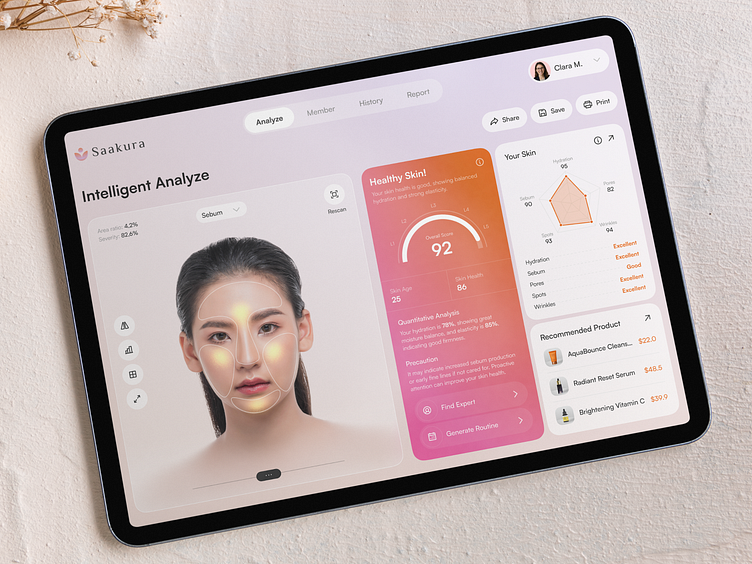
AI platforms typically categorize insights into performance zones. Instead of vague aspirations like “glow,” you’ll see measurable targets such as:
Increase hydration by 18%
Reduce visible redness by 22%
Improve elasticity score by 12%
Stabilize sebum fluctuation index
This reframes skincare as optimization rather than experimentation. ✨
From here, you prioritize. Is barrier repair your foundation? Is pigmentation your main concern? Are you targeting preventative aging?
Data makes your strategy deliberate.
Step Three: Build a Barrier-First Foundation
One of the clearest findings from AI trend analytics in 2026 is this: barrier strength predicts long-term skin resilience more reliably than almost any other metric.
Before layering actives, ensure your baseline routine protects:
Cleanse Without Disruption
AI hydration mapping often reveals that harsh cleansers are a hidden culprit in chronic dryness or reactivity. Choose pH-balanced formulas that maintain lipid structure.
Replenish Structural Lipids
Ceramides, cholesterol, and fatty acids remain non-negotiable. AI systems frequently show measurable improvements in barrier scores within 4–6 weeks of consistent lipid replenishment.
Hydrate Strategically
Rather than overloading with humectants, modern hydration protocols adjust based on environmental humidity data. In low-humidity climates, occlusive layering improves measurable water retention.
Barrier repair is not glamorous — but it is foundational. 💎
Step Four: Layer Actives Based on Evidence, Not Trends
In 2026, ingredient selection is guided by compatibility algorithms. Your AI dashboard might suggest:
Low-dose retinoids if collagen density markers are declining
Azelaic acid if inflammatory clusters are detected
Tranexamic acid if pigmentation mapping shows uneven melanin distribution
Peptides if elasticity score dips below baseline
The difference? Dosage and frequency are optimized based on your response data.
For example, if redness spikes after introducing retinoids, your system may recommend micro-dosing or cycling instead of full discontinuation.
The future of actives is adaptive. 🔬
Step Five: Incorporate Smart Devices Thoughtfully


4
At-home devices have matured significantly. LED masks, microcurrent tools, and radiofrequency systems now integrate with AI dashboards, logging session frequency and correlating them with visible outcome changes.
Data reveals patterns such as:
Improved elasticity scores after consistent red light therapy
Reduced inflammation index following blue light sessions
Enhanced lymphatic drainage reducing transient puffiness
However, AI also flags overuse. More is not always better. Overstimulation can compromise barrier readings and increase redness markers.
Precision applies to devices as much as products.
Step Six: Track, Adjust, Repeat
Perhaps the most revolutionary aspect of AI skin analysis in 2026 is longitudinal tracking.
Instead of judging results emotionally (“I think my skin looks better?”), you can measure:
Hydration delta over 30 days
Pigmentation variance under consistent lighting
Fine line depth percentage change
Sebum stability index
When progress plateaus, algorithms recommend small adjustments — not complete routine overhauls.
Skincare becomes iterative, not impulsive.
The Emotional Shift: From Guesswork to Confidence
Beyond metrics, there’s a psychological benefit to data-backed routines.
Consumers report reduced product fatigue and fewer impulse purchases. Decision-making becomes calmer, grounded. 🌍
Rather than chasing every launch, you evaluate whether a new serum meaningfully improves your baseline scores.
Data introduces discernment.
Privacy, Ethics, and Data Transparency
With increased biometric tracking comes responsibility. In 2026, reputable platforms:
Encrypt skin imaging data
Allow user-controlled data deletion
Provide transparent algorithm explanations
Partner with dermatological researchers
As consumers, discernment matters. Choose platforms aligned with ethical AI standards.
The Role of Dermatologists in an AI Era
AI is not replacing dermatology — it is augmenting it.
Dermatologists increasingly use AI imaging tools during consultations to monitor treatment efficacy. The collaboration between machine precision and clinical expertise creates stronger outcomes than either alone.
Think of AI as a diagnostic co-pilot. 🧬
Minimalism Through Precision
Ironically, more data often leads to fewer products.
When you know exactly what your skin requires, redundancy fades. A 12-step routine may condense to five highly targeted steps — each justified by measurable need.
Precision fosters elegance.
Who Benefits Most From AI Skin Analysis?
While nearly anyone can benefit, certain groups see pronounced improvements:
Individuals with persistent but unexplained irritation
Those managing hyperpigmentation
Consumers navigating hormonal fluctuations
People investing in premium actives seeking measurable ROI
For these users, AI transforms confusion into clarity.
The Future: Predictive Skincare
The next frontier? Predictive modeling.
Emerging platforms forecast:
Breakout likelihood based on cycle data
Seasonal dehydration risk
Cumulative UV exposure impact over years
Collagen decline trajectories
Rather than reacting, you prevent.
Predictive skincare marks the true integration of beauty and biotechnology. ✨
Building Your Data-Driven Routine: A Refined Blueprint
To summarize your pathway:
Establish a baseline scan.
Prioritize measurable performance goals.
Strengthen barrier integrity first.
Introduce actives guided by diagnostic insight.
Integrate devices strategically.
Monitor progress and refine gradually.
This is not about complexity. It is about alignment.
The Luxury of Knowing
In 2026, the most luxurious aspect of skincare is not gold-infused packaging or exotic botanicals. It is certainty.
Knowing your hydration level.
Understanding your barrier resilience.
Tracking collagen support over time.
AI skin analysis has reframed skincare as a disciplined, intelligent practice rooted in science rather than speculation. 🔬
The future is not louder. It is smarter.
And for the first time, your skin routine can evolve with you — guided not by trends, but by truth.
