Morning vs. Night Actives: Timing Your Skincare for Results

Morning vs. Night Actives: Timing Your Skincare for Results
There’s a particular kind of frustration that only skincare lovers know: you invest in beautiful formulas—vitamin C that smells faintly of citrus-clean luxury, a retinoid with the promise of glass-skin clarity, an exfoliant that whispers “polish”—and yet the results feel muted. Sometimes it’s not the product. It’s when you’re using it.
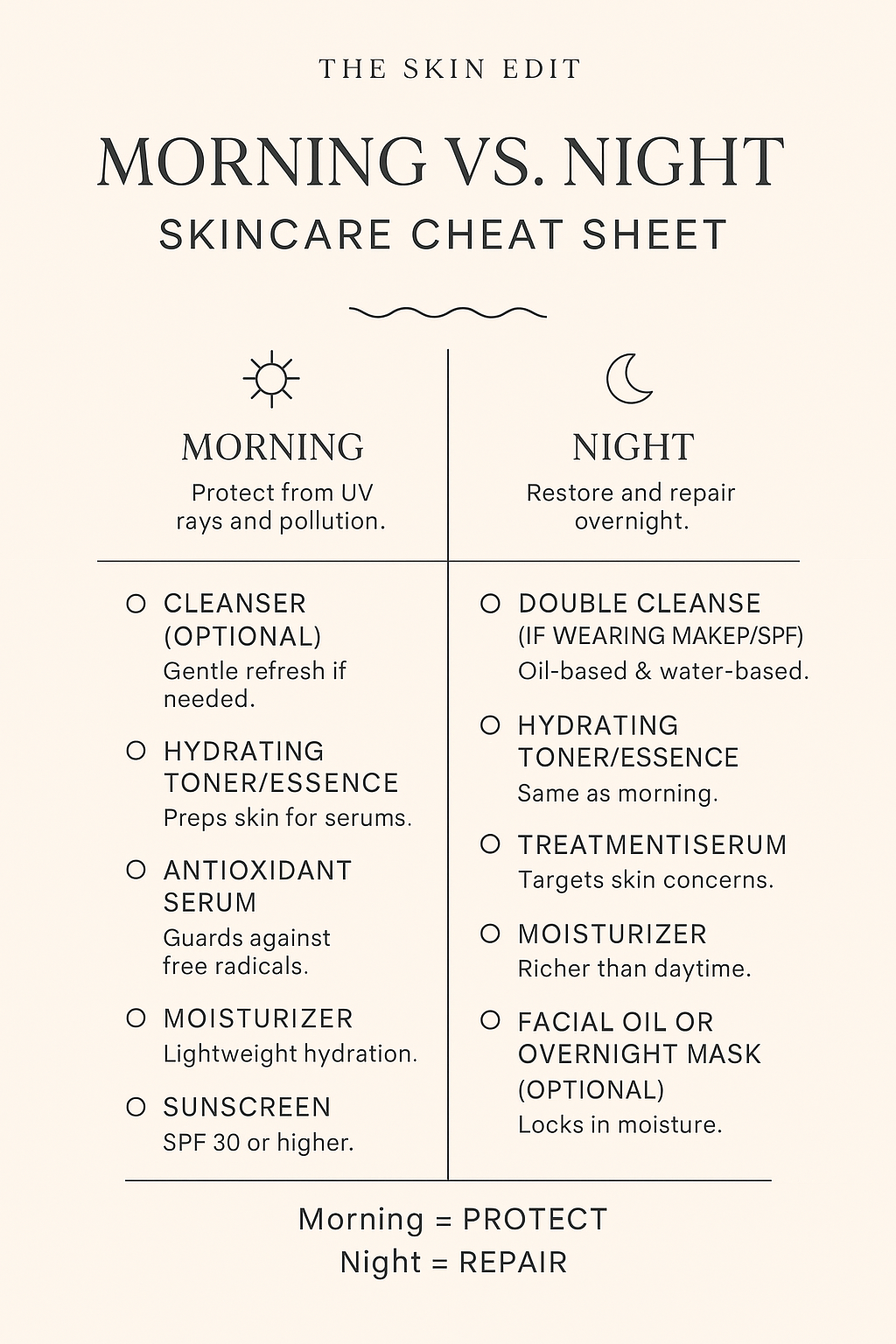
Timing is the quiet, editorial difference between a routine that’s merely “consistent” and one that’s strategic. Your skin behaves differently across the day: defending itself from UV and pollution when you’re awake, then shifting toward repair and renewal as you sleep. That circadian rhythm framing shows up even in consumer education visuals—day as “energise and protect,” night as “repair and renew.”
And then there’s chemistry: some ingredients are happiest under sunscreen and daylight; others are better reserved for nighttime because of irritation risk, photosensitivity concerns, or photostability limits—tretinoin, famously, has been shown to degrade with light exposure, which is a key reason it’s traditionally used at night.
This guide is the elegant blueprint: what belongs in the morning, what belongs at night, and how to arrange actives so they actually deliver—without turning your barrier into collateral damage. ✨
Your skin has a day job and a night shift 🌙🌿
Think of daytime skin as a bodyguard. It’s managing exposure: UV, temperature shifts, friction from masks or collars, and oxidative stress from the world outside. Nighttime skin is more like a restoration suite—less about shielding, more about recovery.
Even if you don’t want to romanticize biology, this day/night split maps beautifully to product performance:
AM routines tend to shine when they focus on protection and prevention: antioxidants + sunscreen.
PM routines tend to shine when they focus on repair and renewal: retinoids, stronger exfoliants, richer barrier support.
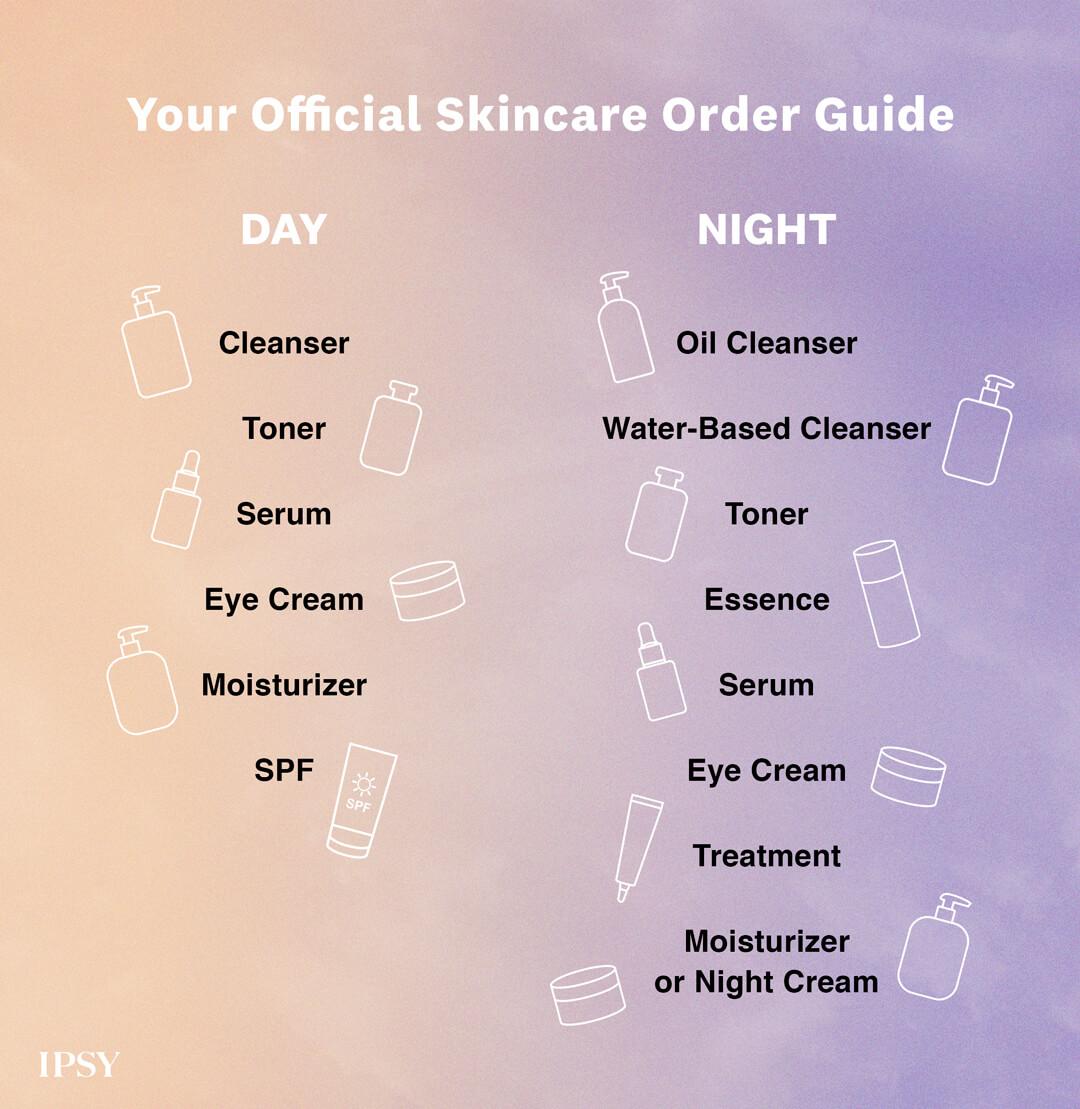
A simple “day vs night order” graphic gets the vibe right—day ends with SPF; night reserves space for treatments.
The more your routine reflects this rhythm, the fewer products you need to see meaningful change.
The AM “power pairing”: antioxidants + sunscreen ✨💡
If you only perfect one timing decision, let it be this: use your antioxidant step in the morning, then seal it with sunscreen.
Why vitamin C is a morning icon
Topical vitamin C is widely discussed in clinical literature for its broad utility—anti-aging support, pigment benefits, and notably photoprotective/antioxidant activity when used topically.
Many clinician-facing summaries also emphasize the practical routine advantage: applying vitamin C before sunscreen in the morning is considered especially advantageous, with retinoids favored at night in that same framework.
What that means in real life: vitamin C doesn’t replace SPF, but it can complement your daytime defense strategy by neutralizing free radicals generated by UV and pollution exposure. It’s the undercurrent of “glow” that reads expensive because it’s quietly consistent.
Other actives that often wear well in the morning
Not everything belongs in the AM, but a few categories typically do—especially when they’re formulated for low irritation and you’re faithful with SPF:
Niacinamide for barrier support and oil-balance (often very AM-friendly).
Azelaic acid for redness, texture, and blemish-prone skin (often tolerated both AM/PM, depending on your skin).
Gentle hydrators (glycerin, hyaluronic acid, panthenol) that make sunscreen and makeup sit better.
The AM goal isn’t to do “more.” It’s to set your skin up to win the day.
The PM advantage: retinoids, renewal, and real repair 🧬🔬
Night is when skincare earns its “treatment” reputation. You’re not layering under sunscreen. You’re not battling humidity swings and touchpoints. And you can tolerate richer textures that help reduce overnight water loss.
Why retinoids are usually PM
Tretinoin (a prescription retinoid) is well-known for photodegradation—research has discussed how tretinoin degrades when exposed to light, which is a key reason it has historically been limited to evening use.
Even for over-the-counter retinol/retinal formulas that may be more cosmetically engineered, night use remains the classic choice because it simplifies the risk equation: less UV exposure + easier barrier support + fewer “invisible” conflicts with daytime products.
And yes—retinoids can increase irritation and may make skin more sensitive if you’re not diligent with sunscreen, which is why many educational materials pair retinoids with daily SPF use.
The real secret to retinoid results
Retinoids are less about hero nights and more about boringly elegant consistency. Start slowly, buffer with moisturizer if needed, and give your barrier the respect it deserves. The most sophisticated retinoid routine isn’t the harshest. It’s the one you can maintain for months.
Exfoliants and photosensitivity: the “nighttime bias” that protects your barrier 🌿
Exfoliants are where timing becomes protective—because they can change how skin reacts to sunlight.
The Skin Cancer Foundation has noted that ingredients that exfoliate or encourage cell turnover are common culprits for photosensitivity, because removing dead cells exposes newer, more delicate skin beneath.
So should you only exfoliate at night?
Many people find that keeping exfoliation in the evening reduces the risk of daytime sensitivity and simplifies routine conflicts. If you’re using stronger exfoliants—or you’re acne-prone and also using retinoids—night use can be the difference between “refined” and “overdone.”
That said, the most important rule is not the clock—it’s your SPF consistency and your barrier tolerance. If your skin flushes, stings, or flakes, timing won’t save you from over-exfoliation. Only restraint will.
The ingredient timing map: what to use when (without turning it into a 12-step ritual)
You don’t need a spreadsheet. You need a principle:
AM = defend. PM = repair. 💎
Typically AM-friendly
Vitamin C + sunscreen pairing
Niacinamide and barrier-supporters
Azelaic acid (often flexible)
Hydrators (glycerin, HA, panthenol)
Typically PM-favored
Retinoids (especially tretinoin) due to photostability issues
Strong exfoliating acids, if you’re prone to sensitivity/photosensitivity
Richer moisturizers and barrier creams
If you remember nothing else: if an active can make you more sun-sensitive or irritated, it’s usually safer at night—and always paired with sunscreen the next day.
Conflict management: when timing prevents “ingredient drama”
Actives rarely fail because they’re ineffective. They fail because they’re piled together in a way skin can’t tolerate.
Retinoids + benzoyl peroxide: complicated, but solvable
Older skincare lore insisted benzoyl peroxide “deactivates” tretinoin. More recent research has shown that some optimized formulations of tretinoin did not degrade when mixed with benzoyl peroxide over a measured period, challenging the blanket claim.
However, even if degradation isn’t the main issue for a given formula, irritation can be—and many clinicians and consumer-education sources still recommend separating these actives to reduce dryness and sensitivity.
The most skin-kind approach:
Use benzoyl peroxide in the morning (if tolerated) and retinoid at night, or
Alternate nights if your skin is reactive.
Retinoids + strong acids: the barrier-risk pairing
Combining a retinoid with AHAs/BHAs in the same session can overwhelm the barrier for many people. Mainstream derm commentary often advises separation (alternate nights or different routines) to limit irritation.
Luxury skincare isn’t “maximal.” It’s precise.
Sample routines that actually work (and feel realistic)
The polished AM routine (4 steps)
Cleanse (or rinse) → antioxidant serum (vitamin C) → moisturizer → SPF
This is the routine that keeps your glow quietly intact through busy days.
The high-impact PM routine (4–5 steps)
Cleanse → hydrating layer → retinoid or exfoliant (choose one) → moisturizer → optional occlusive on dry zones
Retinoids are commonly preferred at night, especially for tretinoin, because of photodegradation concerns.
If your skin is sensitive
AM: gentle hydration + SPF
PM: moisturizer-first “buffering,” then a low-dose retinoid 2–3 nights/week, building slowly.
The routine that works is the one your barrier can sustain.
Quick troubleshooting: when timing is the missing fix
“My vitamin C isn’t doing anything.”
Check whether you’re pairing it with daily sunscreen and using it consistently—vitamin C is often positioned as a photoprotective antioxidant step that complements UV protection.
“My retinoid makes me peel.”
That’s rarely a signal to add more actives. It’s a signal to reduce frequency, moisturize more intentionally, and keep the rest of the routine calm. Also remember: tretinoin is classically a nighttime active due to light degradation—so don’t add daylight stress on top.
“My skin stings after exfoliating.”
That’s a barrier message. Nighttime use may reduce daytime sensitivity risk, but it won’t fix overuse. Photosensitivity can increase when exfoliation reveals newer skin, so simplify and prioritize SPF.
The takeaway
Timing isn’t a skincare trend—it’s skincare literacy.
Use mornings for defense: antioxidants + sunscreen, with calm support around them.
Use nights for renewal and repair: retinoids, carefully chosen exfoliation, and barrier restoration—especially when photostability and irritation risk are part of the story.
When your routine respects both your biology and your chemistry, results stop feeling like luck—and start feeling inevitable. ✨💎
